Is Generic Semaglutide the Same as Ozempic?
A regulator's "same" covers molecule, dose and disease, and leaves the name, the box and sometimes the pen to vary.
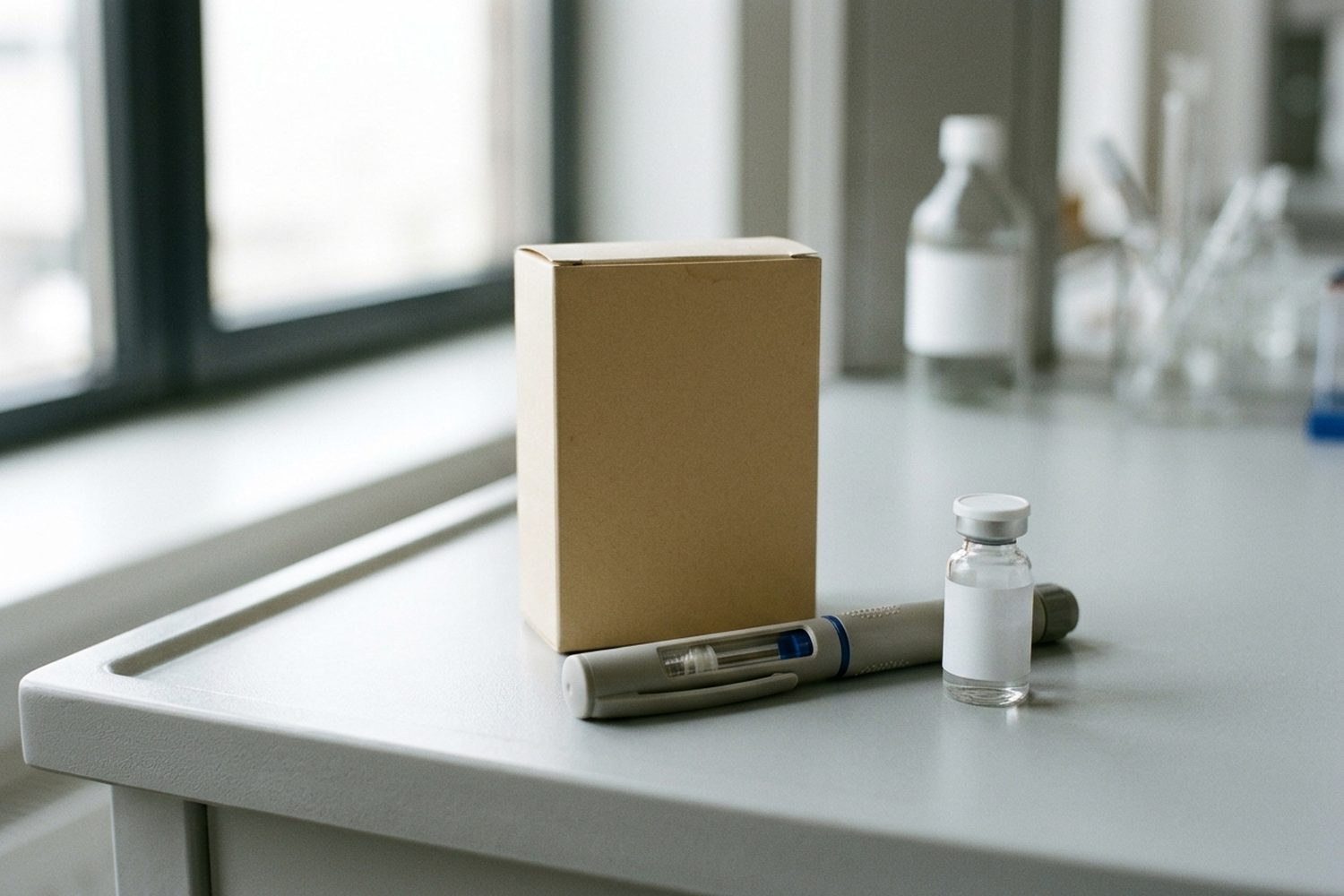
One thing that happens when a drug patent ends is that the word “same” suddenly needs a regulator. For years there was one semaglutide for diabetes, it was called Ozempic, and Novo Nordisk made it. Now Health Canada has approved copies from Dr. Reddy’s and Apotex, India has dozens of them, and people would like to know whether the copy is the thing.
The plain answer is yes, in the specific sense regulators mean it. Generic semaglutide contains the same active ingredient as Ozempic, at the same dose, for the same disease, and it is allowed to differ in everything around that (the name, the inactive ingredients, the look, the packaging, sometimes the injection device). As of September 2026 it was on sale in India, Canada, Brazil, South Africa and Saudi Arabia. It was not on sale in the US, where Apotex holds only an FDA “Tentative Approval” from April 10, 2026, and the compound patent is extended to December 5, 2031 (Novo Nordisk itself reports 2032).
The dumb version says it is the same molecule, so it is the same
Here is the dumb version. Ozempic is semaglutide. The generic is semaglutide. So the generic is Ozempic. Done.
I feel like this is basically correct, which is an awkward thing to admit at the top of an article whose whole job is nuance. The molecule is the medicine. When the compound patent ran out in India on March 20, 2026, more than 40 brands launched the next day, which is what happens when the only thing standing between a market and a molecule is a date.
The dumb version even has some official backing in the US. According to IQVIA, the FDA “treats any peptide chains of under 40 amino acid residues as a generic drug.” Semaglutide has 31 amino acids, so it goes down the ordinary generic road, the Abbreviated New Drug Application that Apotex used. (My entire qualification for discussing peptide chemistry is the ability to count to 40, which turns out to be the relevant skill here.) Tirzepatide has 39. Close call.
The sophisticated version asks what a regulator means by “same”
The sophisticated version starts with a definition. The European Medicines Agency says a generic “contains the same active substance(s) as the reference medicine, is used at the same dose(s) to treat the same disease(s), but may differ in inactive ingredients, name, appearance, and packaging.”
That last clause is the interesting part. “May differ in inactive ingredients, name, appearance, and packaging.” Translated: the drug is identical and everything you can see is allowed to be different.
So “same” to a regulator is not one test but several stacked up. Same active substance. Same dose. Same disease. Health Canada’s description of the Dr. Reddy’s product reads like it was traced over Ozempic’s job description: “indicated for once-weekly treatment of adult patients with type 2 diabetes.” Apotex’s May 1 approval carries the same wording. The generic is not supposed to be a better Ozempic or a different Ozempic. It is supposed to be the Spider-Man pointing at the other Spider-Man.
On the other hand, a generic does not have to copy every job the brand ever had. On June 29, 2026, Health Canada authorized Apotex’s Sevmia, the first generic semaglutide for weight loss, for patients 12 and over, “as a supplement to a reduced-calorie diet and increased physical activity for chronic weight management.” Same molecule, different job, different name. (Whether that makes it a generic Wegovy is a naming fight another article on this site handles.)
Proving a peptide copy is the same takes longer than saying it
Here is the catch with “same active substance.” You cannot just declare it. You have to show that your semaglutide, made your way, gets into the body and behaves there the way Novo Nordisk’s does, closely enough that the gap does not matter. In plain words: make your own, then prove the body cannot tell. The official name is bioequivalence.
For small-molecule pills this is the well-worn part of the process. For an injected peptide, according to industry commentary on the Apotex approval, it “carries a higher analytical burden.” In practice that means more lab work before anyone gets to say “same.” Somewhere a chemist is saying “hey guys, the data matches, can we please be done,” and somewhere a reviewer is saying “one more batch” (I am inventing both of them, though not the dynamic).
China shows how long the long road can be. Its compound patent expired on March 20, 2026, the same day as India’s. Hangzhou Jiuyuan Gene Engineering said back in April 2024 that its version had achieved “comparable efficacy and safety to Ozempic,” and Jiuyuan Genetic Biopharmaceutical’s application for a Wegovy copy was accepted for review in February 2026. As of October 2026, China had approved zero generic semaglutides, with data exclusivity there running to roughly April 2027. The molecule was free. The paperwork was not.
The pen is where “same” gets expensive
Between us, the molecule is the boring part. The interesting part is the plastic thing you inject it with.
Pen device patents for semaglutide in Canada are reported to run to at least 2033, years past the compound. So the drug can go generic while the delivery hardware stays protected, and the facts available here do not settle exactly how each Canadian generic handles that. In India, where the market answered the question directly, Natco and Eris charged about three times as much for a semaglutide autoinjector pen as for a vial of the same molecule. Same drug. Triple price.
Let me push this, in an invented scenario. Suppose a generic maker has to avoid every claim in a pen patent. It removes the dial, then the click, then the little window, then the cap shape, until it ships a device that works by turning a brass knob seven times while held at a precise angle, and a regulator reviews it and finds it delivers “the same dose(s).” The patent lawyers are delighted. The regulator is satisfied. It is the same drug. It is also, I mean, a brass knob.
For contrast, Teva’s authorized generic liraglutide, the Victoza equivalent, comes in the same 18 mg/3 mL strength and uses the same pen device as the brand-name product. That is one way to make “same” easy.
What patients notice about generic semaglutide, and why both roads end in the same place
What does a patient actually see? Mostly the things the EMA said could differ: a different name, a different box, maybe a different device, and a different price. In India, Ozempic had cost about ₹8,800 to ₹11,175 a month (roughly $100 to $130); generics came in at ₹1,800 to ₹4,200 (roughly $20 to $50). Novo Nordisk cut Ozempic by 36% and Wegovy by 48% within about 10 days, and generics still took 50% of semaglutide sales by value in April 2026. India’s regulator, CDSCO, said on March 24 that it had inspected 49 entities and issued notices related to generic promotion, which suggests some of the marketing was creative.
In Canada, approval is not the same as access. Provincial formulary listings, not the Health Canada authorization itself, decide what people can actually get and how hard prices compete. That matters in a country where Ozempic was the best-selling drug of 2025, at $2.9 billion in sales and more than three times the runner-up, with over one million Canadians on it. Canada got there first among G7 countries because a Novo Nordisk patent lapsed in 2019 over a CAD $250 maintenance fee (roughly $180, lol), a story another article tells in more loving detail.
So here is where the two versions end up. The dumb version said: same molecule, same drug. The sophisticated version said: same active substance, same dose, same disease, demonstrated bioequivalence, with the name, appearance, packaging and possibly the device free to vary. I suppose that is the same answer, reached by a longer road and a lot more batch testing. It is the same drug in a different box, and sometimes the box is spelled differently.
The Health Canada press release calls Apotex’s weight-loss semaglutide “Sevmia.” The CNW Group press release for the same product calls it “Svemia.”
Sources
- Canada becomes the first G7 country to approve a generic version of semaglutide - Canada.ca
- Semaglutide Generics, Six Months In: Every Launch in India, Every Price, and Where China Stands
- Canada approves second generic semaglutide, the first G7 country to do so - BioSpace
- Generic and hybrid medicines | European Medicines Agency (EMA)
- Semaglutide Patent Status by Country 2026 | Generic Guide
- The GLP-1 Patent Landscape in 2026: Who Holds What, and When It Opens Up | Patenta.ai
- Apotex Receives First U.S. FDA Tentative Approval for a Generic Version of Ozempic® (Semaglutide Injection) in Partnership with Orbicular
- Apotex’s Generic Ozempic® (Semaglutide) Secures First FDA Tentative Approval | Pearce IP
- Novo’s Ozempic, Wegovy to Face Stiff Generic Competition in China: Reuters - BioSpace
- Generic Liraglutide Costs in 2026: Insurance vs. No Insurance
- Canada approves first generic semaglutide for weight loss - Canada.ca
- Canada approves first generic semaglutide for weight loss
- Canada approves first generic semaglutide for weight loss
- Your Questions Answered: Off-patent Semaglutide in 2026 | IQVIA
- Apotex Gets Health Canada Approval for Generic Semaglutide
- Canada approves generic semaglutide from Dr. Reddy's, a G7 first enabled by Novo Nordisk's lapsed CAD$250 patent
- Semaglutide Patent Cliff: Who Wins, Who Loses?
- Drug Patents Expiring in 2026: A Comprehensive Guide | IntuitionLabs
- Jiuyuan Genetic Biopharmaceutical’s Marketing Application for Generic Wegovy® Accepted for Review in China | Pearce IP
- Jiuyuan files China approval bid for Wegovy generic | Pharmaceutical | The Pharmaletter
GLP Generic explains patents, approvals and published research. It is not medical advice, and it never recommends a dose, a product or a seller. Talk to a clinician before you start, stop or change any medicine.