Generic Semaglutide in India: The 2026 Cliff
A court let Indian makers export semaglutide but not sell it at home, until the patent calendar ended the argument and prices fell.
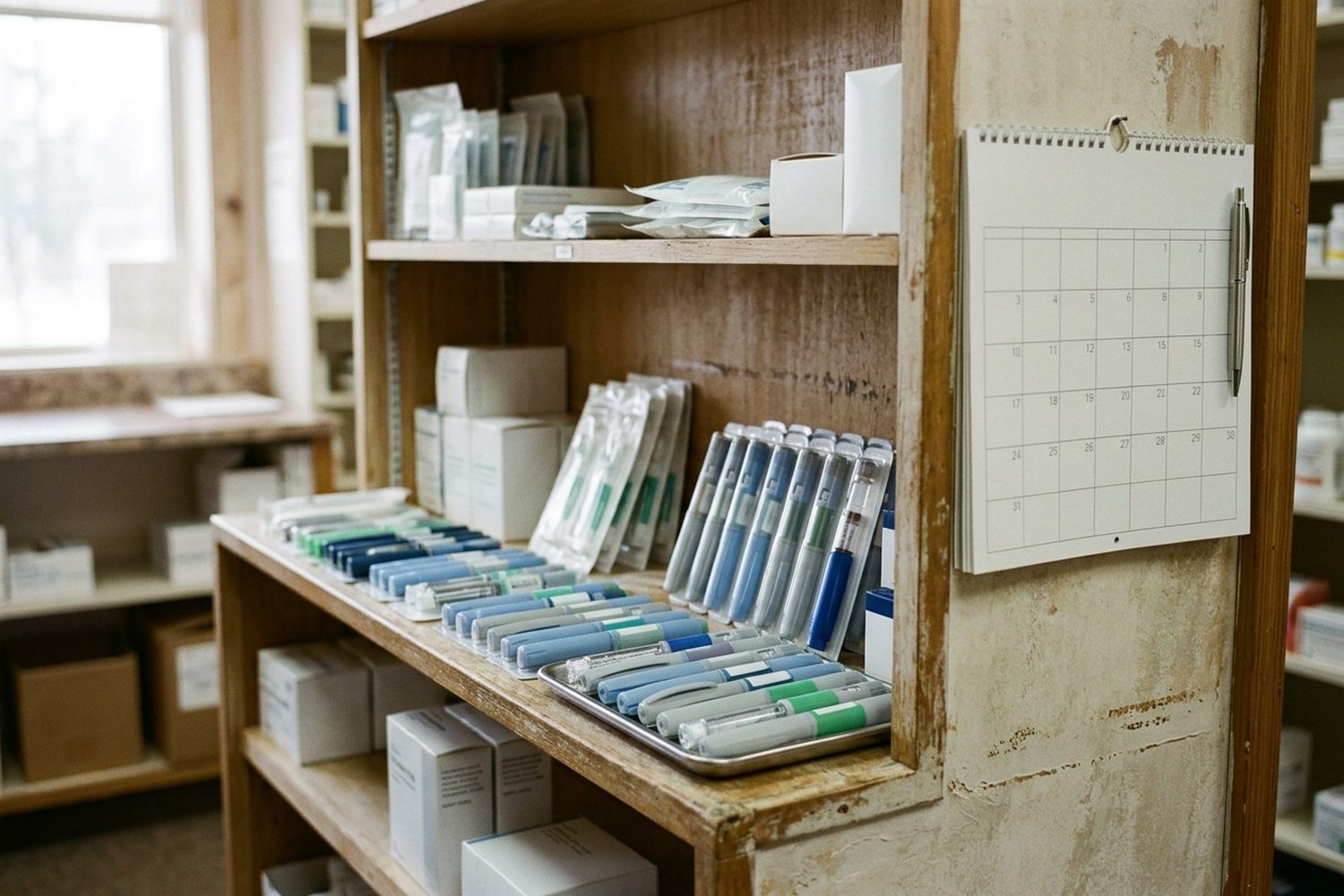
For a while, an Indian court let Indian drugmakers manufacture semaglutide in India and sell it almost anywhere in the world except India. Then, on March 21, 2026, the “except India” part expired, and so did a lot of prices.
That is the short answer for anyone searching generic semaglutide india. Novo Nordisk’s compound patent on semaglutide lapsed in India on March 20, 2026, and generic injectable versions went on sale the next day. Branded Ozempic had been selling for ₹8,800 to ₹11,175 a month (roughly $100 to $130), and the generics arrived at ₹1,800 to ₹4,200 (roughly $20 to $50). The pill version is a separate matter and stays blocked until 2031.
The sentence, read like a contract
Here is the sentence I want to read slowly. MedPath, reporting on the litigation, wrote that “The Delhi High Court allowed Dr Reddy’s and OneSource Specialty Pharma to export semaglutide to countries where Novo Nordisk does not hold patent protection, while prohibiting domestic Indian sales until March 2026.” It is an ordinary sentence in a news story. It is also, read as if it were a contract, a pretty complete description of how a patent cliff works in a country that makes drugs for export.
Start with “allowed.” You only get allowed to do something somebody was trying to stop. Novo held an Indian patent on the molecule, and a patent is, in some sense, a legal right to make other people ask permission. The court gave some permission. Not all of it.
“Dr Reddy’s and OneSource Specialty Pharma.” Two companies, named. Not “the Indian generics industry,” which would show up later in force. (The headline on that story also mentions a challenge to the validity of Novo’s patent; the sentence I am reading does not say how that came out, and I won’t guess.)
“To export semaglutide.” This is the interesting verb. A patent is national, and the court’s answer, as reported, was that the making could happen here as long as the selling happened somewhere else.
“To countries where Novo Nordisk does not hold patent protection.” This looks like a list of countries. It is actually a list that changes on known dates. Novo’s core compound patent was filed on March 20, 2006, which gives a baseline 20-year expiry of March 20, 2026 anywhere nobody extended it. So the set of countries Dr. Reddy’s could ship to was, basically, a set that was scheduled to get much bigger on one specific Friday.
“While prohibiting domestic Indian sales.” The one market the product definitely could not reach was the market of the country where the companies are based. (The sentence does not say where the factories are.)
“Until March 2026.” The prohibition had an expiry date, and it was the patent’s expiry date. So the court did not really decide whether India would get cheap semaglutide; the calendar had already decided that. The court decided what the Indian companies were allowed to do while they waited.
They waited very efficiently.
What generic semaglutide in India looked like on day one
By the time the date arrived, the companies were not starting from scratch. In January 2026, Sun Pharmaceutical, Zydus Lifesciences and Alkem Laboratories received approval in India to manufacture and sell generic versions of Wegovy and Ozempic. Companies that announced launches on or before March 21 include Dr. Reddy’s, Sun Pharma, Zydus, Torrent, Alkem, Glenmark, Natco, Eris and USV.
How many showed up on day one? The tracker Generic Guide says generic semaglutide arrived “with more than a dozen manufacturers launching on day one.” That’s a clean number. Actually, it isn’t clean, which is the more interesting fact: one compilation counts “over 40 generic semaglutide brands” launching on March 21, while a six-month review counted 12 makers publicly selling 20 brands as of October 8. Those are different things being counted (manufacturers, brands, announcements versus public launches), and the sources do not reconcile them. What is settled is that the answer is “a lot,” on the same morning, for the same molecule.
Here is an invented scene, clearly made up. A pharmacist on March 20 stocks one semaglutide pen and knows its price. On March 21 she has a dozen boxes from a dozen companies, all with the same active ingredient and different logos, and by the time she has alphabetized them two more sales reps arrive, each explaining (truthfully) that the molecule is identical and (hopefully) that their box is nicer. By June she is running the shelf like a fantasy football draft, tracking injury reports on supply. By October she needs a spreadsheet to tell her which of twenty brands is cheapest this week. It is Natco or Eris, at ₹1,290 a month for vials (roughly $15), as of October 8.
Novo’s response, and why everyone did the sensible thing
Within about ten days of the launches, Novo Nordisk cut the price of Ozempic in India by 36% and Wegovy by 48%. Price cuts like this are, formally, voluntary.
You can see why each party behaved the way it did. Novo, facing twenty brands of its own molecule, can either keep its price and watch the volume leave, or cut and keep some of it; every week at the old price is a week of patients and pharmacies learning the generic names. The generic makers, selling something that is by design the same as everyone else’s, have basically one thing to compete on, which is the number on the box (Dr. Reddy’s was reported in February 2026 as hoping to launch up to 60% below Wegovy). And patients and payers, offered the same molecule for a fraction of the price, behave like people offered the same molecule for a fraction of the price.
The April numbers show the result in two ways that look contradictory and aren’t. Generics were 137,000 of 170,000 injectable semaglutide units sold in India, or about 4 in 5. By value they were ₹44 crore of an ₹88 crore market (that’s roughly $5 million of roughly $10 million), or exactly half. Four-fifths of the units, half the money. That’s fine; that is just what “cheaper” means when you write it as a market share. (One source calls April “two months after patent expiry,” which is generous counting, since the expiry was March 20.)
I mean, you could picture the meeting. “Hey guys, so the price we’ve been defending since launch, we’re going to take about half of it off, effective now.” Nobody in that meeting is surprised. The date was on the patent.
Why the export clause matters more after the cliff
On the other hand, the domestic market is now a place where twenty brands fight over a price that keeps falling. The export clause from the court sentence starts to look like the real prize. As of September 2026, generic semaglutide was on sale in India, Canada, Brazil, South Africa and Saudi Arabia. Health Canada approved Dr. Reddy’s generic on April 28, 2026 (the Canadian patent lapsed over an unpaid fee, which is a story for another article). Brazil refused Novo a patent term extension and approved its first generic in May. Saudi Arabia, where no local patent was reported, saw its first generic launch on September 16.
Where those exported pens are actually made, the sources here do not settle, and I won’t pretend they do. But the logic of the court’s sentence is that the list of “countries where Novo Nordisk does not hold patent protection” is the addressable market for anyone in India with an injectable line, and the list is published in advance. One analysis sorts it into waves: 2026 for India, China, Brazil, Canada and South Africa; around 2031 for the UK, the big four EU markets and Japan; 2032 to 2033 for the US. Apotex got the first US tentative approval for a generic Ozempic in April 2026, and “tentative” there means roughly “approved, pending the calendar.”
China is the odd one. Its compound patent expired on March 20, 2026, the same day as India’s. As of October, zero generic semaglutides had been approved in mainland China, because data protection there runs to approximately April 2027. Same molecule, same patent date, different lock.
The pill is a separate contract
Anyway, everything above is about the injection. A formulation patent covering the SNAC absorption enhancer (the ingredient that lets semaglutide survive being swallowed, in a specific range) runs to 2031 in India, which blocks a generic version of the oral tablet even though the compound patent is gone. So India has, as of now, twenty-ish cheap injectable brands and no cheap pill, because of a patent on the thing that helps the drug get absorbed. Lol, but also: that is exactly what the patent says.
Presumably the lawyers who drafted the oral formulation patent knew what the compound patent’s expiry date was. Different patents end on different days, and each one is read as literally as the court sentence above.
If you are an Indian generic maker watching your domestic price fall toward ₹1,290 a month, you had better find a lot more countries where Novo Nordisk does not hold patent protection.
Sources
- Semaglutide Patent Status by Country 2026 | Generic Guide
- The GLP-1 Patent Landscape in 2026: Who Holds What, and When It Opens Up | Patenta.ai
- Semaglutide Generics, Six Months In: Every Launch in India, Every Price, and Where China Stands
- Apotex’s Generic Ozempic® (Semaglutide) Secures First FDA Tentative Approval | Pearce IP
- Semaglutide Patent Cliff: Who Wins, Who Loses?
- Jiuyuan Genetic Biopharmaceutical’s Marketing Application for Generic Wegovy® Accepted for Review in China | Pearce IP
- Canada approves generic semaglutide from Dr. Reddy's, a G7 first enabled by Novo Nordisk's lapsed CAD$250 patent
- Semaglutide Brand Names in India by Company (2026) | ALTRcare
- Delhi High Court Allows Dr. Reddy's to Export Semaglutide, Challenges Novo Nordisk Patent Validity - MedPath Trial
- Apotex Receives First U.S. FDA Tentative Approval for a Generic Version of Ozempic® (Semaglutide Injection) in Partnership with Orbicular
GLP Generic explains patents, approvals and published research. It is not medical advice, and it never recommends a dose, a product or a seller. Talk to a clinician before you start, stop or change any medicine.