Generic Victoza Is Already Here, and It Tells You What Comes Next
The first American generic GLP-1 came from the brand's own plant, in its own pen, at a price that barely flinched.
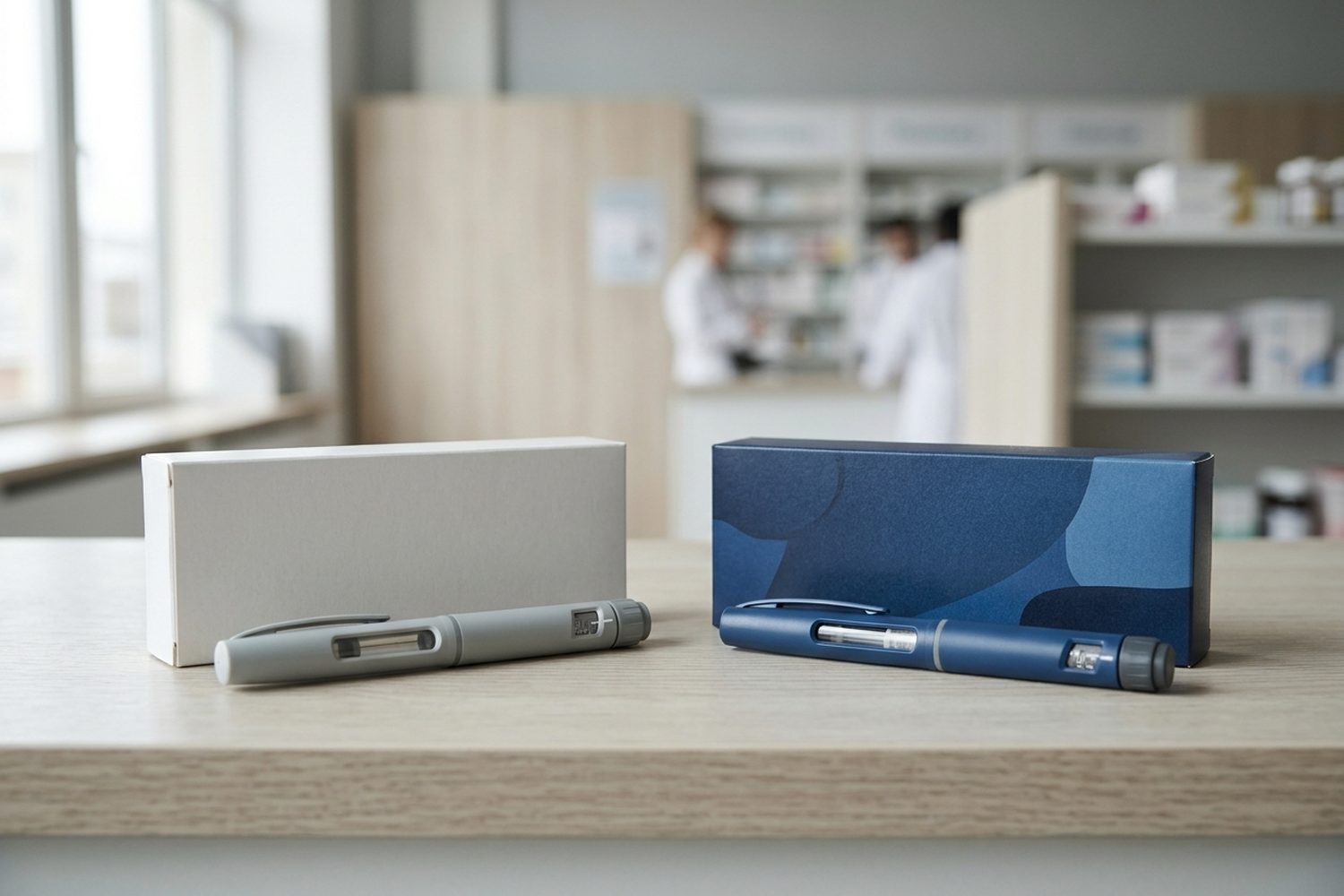
On June 24, 2024, Teva Pharmaceuticals launched the first generic GLP-1 drug ever sold in the United States, and it was made by Novo Nordisk. Novo Nordisk is the company that makes the brand. Teva’s product was an “authorized generic” of Victoza (liraglutide injection 1.8 mg), launched under a 2019 patent settlement between the two companies, and one consumer guide put it plainly: “Both Teva’s authorized generic liraglutide and brand-name Victoza are manufactured by Novo Nordisk.” Same 18 mg/3 mL strength. Same pen. Different box.
So the plain answer on generic victoza is that it exists, it has existed since mid-2024, and there are now several versions. After Teva came Hikma, whose traditional (non-authorized) generic liraglutide got FDA approval on December 23, 2024 and launched in early 2025, and then Meitheal, approved on April 2, 2025 and launched the following day. In August 2025 Teva also launched a generic of Saxenda, the higher-dose liraglutide for weight loss. The price did fall. It just did not fall the way people picture when they hear the word “generic,” and the reasons are a decent preview of what happens when the bigger GLP-1 drugs lose protection.
Who launched generic Victoza, and in what order
The chain starts with patents. Novo held them, Teva wanted to sell liraglutide, and instead of litigating to the end they settled in 2019 and picked a date. Teva would go first, and as the first filer it got six months of exclusivity, after which DiaTribe reported that Sandoz and Viatris “could launch as soon as December 2024.” (Viatris is the company formerly known as Mylan, which is the sort of fact that matters only in pharma and in pub trivia.)
You can picture the meeting. “Hey guys, instead of spending five years arguing about whether this patent is valid, what if we just agree on a Tuesday?” Everybody acting sensibly here, from where they sit: Novo would rather the first generic be one it manufactures, Teva would rather have a guaranteed launch than a coin flip in court, and both would rather skip the legal bills. It’s fine. It’s what settlements are for.
The result is an arrangement where the generic is made in the brand’s plant, filled into the brand’s pen, launched on a date the brand signed off on, and sold by a company that used to be suing the brand. They share a molecule, a factory, a device and a calendar. The line between the two products is, let’s say, blurry. (The financial terms of the settlement are not in the sources here, so who earns what on each box is not settled.)
Then the field widened. Hikma’s version was the first traditional generic liraglutide, meaning it was not a relabeled Novo product. Meitheal launched in 3-pen packs, with plans to expand. Sandoz and Viatris were reported to be developing versions as of June 2024. The sources also disagree, a little, about which of these was “first,” because the Victoza authorized generic, the Hikma generic and the Saxenda generic each got called the first something. Pharma firsts are sort of like airline loyalty tiers: there are a lot of them, and each one is technically true.
What the price of generic liraglutide actually did
At launch, Teva priced its two-pack at $469.60. The brand was about $560. DiaTribe called that “only a 16-17% price reduction,” and the word “only” is doing honest work.
I want to dwell on $469.60 for a second, because it is a wonderful number. It is not $470. Someone decided that the sixty cents mattered (and presumably there was a slide about it). And the three-pack was $704.40, which is exactly one and a half times $469.60, so every pen in either package cost precisely $234.80. This is a price set by people who know their unit economics to the penny and decided the penny should stay. Victoza had annual sales of $1.656 billion as of April 2024, so, look, the pennies add up.
For contrast, a source on biosimilar and peptide pricing says US peptide generics “typically achieve only 15-40% price reductions versus reference products,” against 80-90% discounts typical for small-molecule generics, because the approval pathway is more expensive. Teva’s launch landed near the bottom of even that modest range.
It did move after more sellers arrived. As of 2026, the average GoodRx price range for Teva’s generic liraglutide is $200 to $450 for a 2-pen package and $280 to $750 for a 3-pen package. The low end is well below launch. The top of the 3-pen range is above Teva’s launch price, which tells you that a “range” covers a lot of pharmacies doing a lot of different things, etc. What the typical patient paid at any given counter is not settled by these figures.
Why the discount stayed small for so long
The point is that a 90% price drop needs a crowd. It needs a dozen manufacturers who each think undercutting the others is their best move. For six months, generic Victoza had one generic seller, and that seller’s product came off the brand’s own line. A one-company price war is a dumb idea, and nobody in this story had it.
Here is an invented scenario, clearly made up, to show the logic. A pharmacy stocks brand Victoza and Teva’s authorized generic, both from the same Novo plant. A patient asks the pharmacist which is better. The pharmacist says they are identical, except one is $90 cheaper. Novo, seeing this, could launch a second authorized generic through another partner at $469.59. Then a third at $469.58. In theory the market fills with Novo-made liraglutide in a dozen boxes, each a cent cheaper, and the “competition” is a single factory racing itself down the price ladder one penny at a time. It never happened. But it explains why the real discount moved when Hikma and Meitheal showed up, not before.
There is also a patent overhang. Liraglutide’s compound patent has expired, but a device patent on the injection button (US 9,265,893) runs to September 2032, and a method-of-use patent for cardiovascular conditions (US 9,968,659) runs to January 2037. One patent analysis describes this as “creating potential litigation risk for generic manufacturers despite the compound patent’s expiry.” If you are a generic company, that risk is a reason to enter carefully or not at all, and every company that stays out is one fewer seller pushing the price down. (The site’s article on the GLP-1 patent thicket covers how these stacks get built.)
Did generic Victoza help with the shortage
The honest answer is that the sources here do not measure it. What can be said follows from the structure. An authorized generic made by Novo Nordisk adds a label, not a factory, so on its own it does not add supply; it moves existing pens into a cheaper box. Hikma and Meitheal are separate products, but how and where they are made is not described in these sources, so whether they meaningfully eased supply is not settled. For instance, a shortage caused by limited filling capacity would not be fixed by a new price tag, however carefully the sixty cents were chosen.
What generic Victoza says about semaglutide
Compare India. When the core semaglutide patent expired there, over 40 generic brands launched on March 21, 2026, the day after expiry. Roughly ten days later, Novo cut Ozempic’s Indian price by 36% and Wegovy’s by 48%. That is what a crowd does. Liraglutide in the US got a negotiated date, a single first seller made by the brand, and a 16-17% discount, with larger cuts arriving only as independent sellers trickled in. (The country-by-country timelines for semaglutide are in the site’s other articles, and I won’t repeat them here.)
So the American liraglutide story is less a race than a relay where the brand hands the baton to a partner it chose, then watches for whoever else shows up. I guess the main thing to watch with semaglutide in the US is not the expiry date by itself but how many strangers are allowed in on it, and when.
The first American generic GLP-1 came out of Novo Nordisk’s own plant, in Novo Nordisk’s own pen, at $469.60. The next ones will come out of somebody else’s. That is when the price moves.
Sources
- Generic Victoza Now Available in the U.S. | DiaTribe
- The GLP-1 Patent Landscape in 2026: Who Holds What, and When It Opens Up | Patenta.ai
- Teva Announces Launch of Authorized Generic of Victoza® (liraglutide injection 1.8mg), in the United Stat
- Generic Victoza (Liraglutide) GLP-1 Is Available in the U.S.
- Generic Liraglutide Costs in 2026: Insurance vs. No Insurance
- Semaglutide Patent Status by Country 2026 | Generic Guide
- Teva Announces FDA Approval and Launch of Generic Saxenda® (liraglutide injection) – First Generic GLP-1 Indicated for Weight Loss
- When Will Generic Semaglutide Be Available? | Prost Biotech
- Victoza patent expiration
GLP Generic explains patents, approvals and published research. It is not medical advice, and it never recommends a dose, a product or a seller. Talk to a clinician before you start, stop or change any medicine.