The Ozempic Price Without Insurance, Explained Without Panic
One molecule, several prices, and a cash market that keeps falling without a single US generic on the shelf.
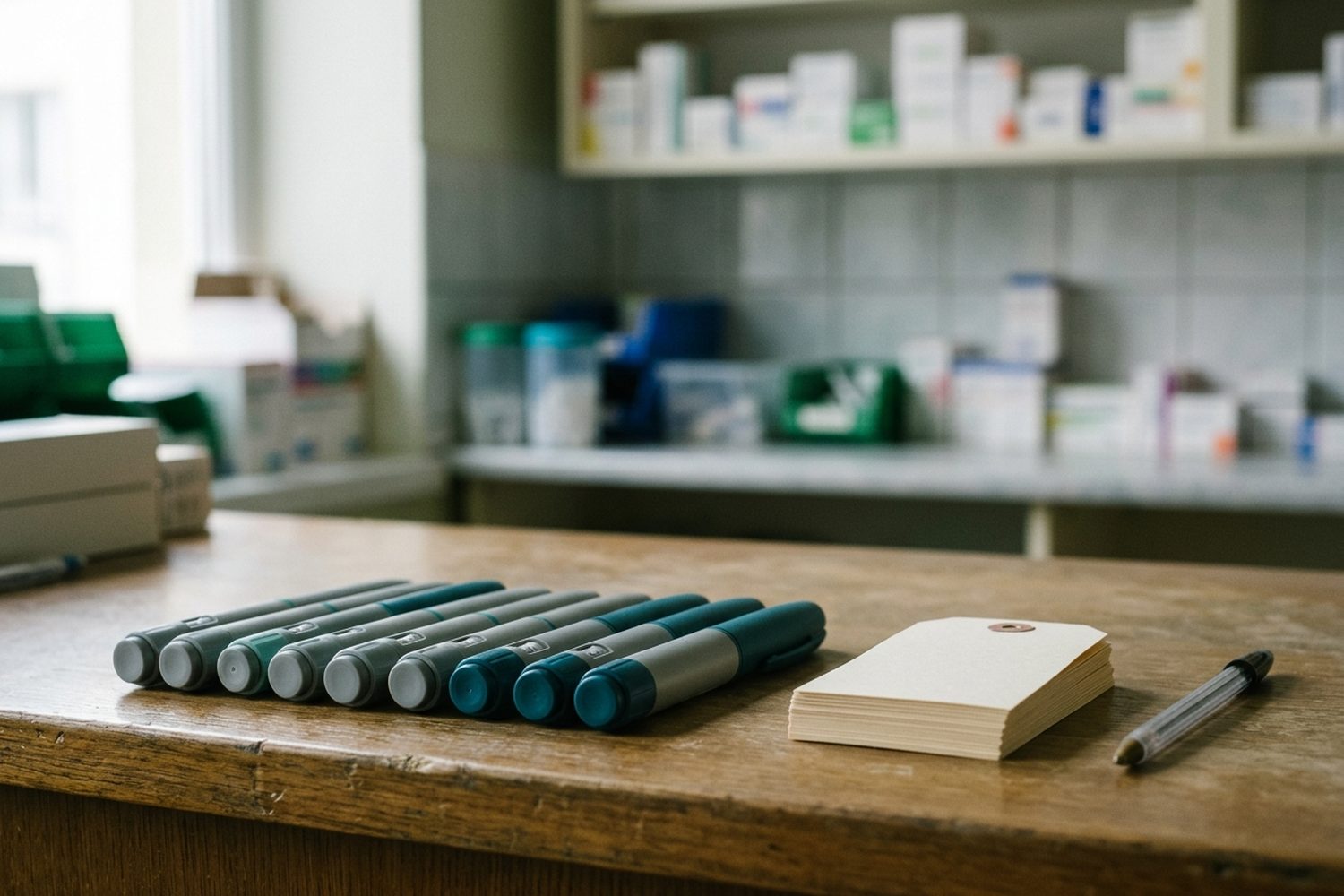
Novo Nordisk sells one molecule at a surprising number of prices, and which one you pay depends mostly on which door you walk through. In 2024 the US list price of Ozempic was $959 for a 30-day supply, and a 2026 guide to compounding law put the ozempic price without insurance (brand-name Ozempic or Wegovy, bought at a regular pharmacy) at “$935 to $1,349 per month.” That is the number most people find when they search. It is a real number. It is just not the only one.
The other door is Novo’s own pharmacy. As of October 21, 2026, the self-pay price for Wegovy through NovoCare Pharmacy started at $199 a month for the pen and $149 a month for the pill. Wegovy and Ozempic are both semaglutide (the same US patents cover both), but they are separate products with separate labels, and the facts here do not settle what a comparable direct cash price for Ozempic itself is. So the plain answer is roughly a thousand dollars a month at the counter, around a fifth of that for the sister product bought directly from the manufacturer, and an Ozempic-specific direct number that is not pinned down here.
What the Ozempic price without insurance is made of
The arrangement looks a lot like a hotel. There is a rate printed on a card on the back of the room door, and there is the rate the hotel’s own website will sell you that same room for tonight. The door rate is real in the sense that it is printed. The website rate is real in the sense that people book it.
Why would a company keep both? I assume because the list price is the starting point for a lot of other arrangements (insurers, pharmacy benefit managers, government programs, etc.), and cutting it moves all of those at once. A separate cash channel lets you charge uninsured people less without touching the number everything else is built on. It’s fine. It is how a great many things are priced. It just means that “what does Ozempic cost” turns into a Price Is Right round where several different guesses are correct and the host does not say which one counts.
The dumb version: generics arrive and the price falls
The simple story of drug prices goes like this. A company gets a patent, the patent runs out, other companies make copies, the copies are cheaper, and the original gets cheaper too. I call this the dumb version with affection, because in India in 2026 it is more or less exactly what happened.
Novo’s core semaglutide patent was filed on March 20, 2006, which gave it a 20-year term ending March 20, 2026 in countries that did not extend it. India was one of those. On March 21, the day after expiry, over 40 generic semaglutide brands launched. Sun Pharma’s launch price per weekly injection worked out (by one outlet’s calculation) to roughly 61% to 66% below Novo’s branded monthly price band. Within about ten days Novo had cut the price of Ozempic in India by 36% and the starting dose of Wegovy by 48%, the latter on April 1.
That is a company making a modest adjustment to its plans. Forty competitors showed up overnight and it rethought things in a week and a half. Nobody had to order it to.
Some countries do not even leave the size of the discount up to the market. Under Brazilian law, a generic has to be sold at least 35% below the reference product’s price, and when several generic makers enter, the cuts there typically reach 50% to 80% below the originator. That is the dumb version written into statute, which is its own kind of compliment (the legislature trusted the simple story enough to make it mandatory).
The broader data says the same thing with more decimals. FDA figures show generic prices about 39% below the brand with one generic maker and more than 95% below with six or more. Look, forty is more than six.
The sophisticated version: no generics, and the price falls anyway
The United States did not get the dumb version. Here the compound patent, US 8,129,343, was extended through patent term restoration to December 5, 2031, which is exactly 14 years after the FDA approved Ozempic on December 5, 2017. Novo itself lists 2032 as the effective US compound expiry, and secondary patents run to 2038. Apotex got the first FDA tentative approval for a generic Ozempic on April 10, 2026, which is an approval with the word “tentative” doing a lot of work in it.
Novo also settled its US Ozempic patent fights with Alvogen, Rio Biopharmaceuticals, Sun Pharma, Dr. Reddy’s, Mylan, Zydus and Apotex, and all of the settlement terms are confidential. (So when any of them may actually launch is not settled, at least not publicly.) It must be a real strain for seven generic companies to sit on information like that, and I am sure they would announce their launch dates tomorrow if only the paperwork allowed it.
So: no generic semaglutide for sale in America. And yet the cash price came down anyway, by a longer road. Compounding pharmacies sold injectable semaglutide for an average of $230 a month, more than half off the brand (that is a whole other story, told elsewhere on this site and not here). Then semaglutide was picked for the second round of Medicare price negotiation under the Inflation Reduction Act, and the negotiated price for Ozempic, Wegovy and Rybelsus is $274 per 30-day supply starting January 1, 2027. DrugPatentWatch notes that this “represents a 71% reduction from the 2024 list price of $959.” And then there is NovoCare, selling the Wegovy pen from $199.
I picture the pricing meeting going something like this (I am inventing it): “Great news, we are cutting the price.” “Which price?” “Not that one.” The point is that India got a big cut because forty rivals walked in the front door, and the US got a cut of a similar size because compounders, the federal government and the company’s own cash program all came in through side doors. Different road. Same neighborhood.
Why the cash price can still move up
To be fair, cash prices are not a one-way street. Eli Lilly raised the UK price of Mounjaro, its rival drug, in about September 2025, and Pharmaceutical Technology reported the stated reason as a move to “better reflect market conditions.” Market conditions, in that sentence, were being reflected upward.
Nor does generic entry in the US guarantee the Indian-style plunge. Peptide copies here have tended to come in only 15% to 40% below the reference product, against the 80% to 90% discounts typical for simple pill generics, because the approval path is more expensive. The nearest test case is liraglutide, the older GLP-1 sold as Victoza. When Teva launched its generic, DiaTribe described the launch price as “only a 16-17% price reduction” from the brand, with more competitors expected to follow. In 2026 the average GoodRx range for Teva’s generic liraglutide was $200 to $450 for a two-pen package. That is cheaper. It is not cheap.
What happens to the cash market from here
The calendar is fairly crowded. Medicare’s $274 price takes effect in January 2027. China’s compound patent also expired on March 20, 2026, but data protection there runs to about April 2027, and at least 17 Chinese manufacturers are in late trials or awaiting approval. US generics are tied to a 2031 or 2032 patent date and to settlement terms nobody will discuss. I guess that leaves the American cash price to be set the way it has been set lately, by competition that does not technically exist yet and by a manufacturer pricing against it in advance.
Which produces one odd result. Come January, the price the federal government spent a statutory negotiation winning for Wegovy will be $75 more than the starting price Novo already charges people with no insurance at all.
Sources
- Semaglutide Compounding Pharmacy: What's Legal In 2026
- Semaglutide Patent Status by Country 2026 | Generic Guide
- The GLP-1 Patent Landscape in 2026: Who Holds What, and When It Opens Up | Patenta.ai
- The 14-Year Cap: How Patent Term Extension and NCE Exclusivity Set GLP-1 Exclusivity - DrugPatentWatch – Transform Data into Market Domination
- Overpatented 2025 – I-MAK
- Generic Weight Loss Pen Brazil: Timeline and Pricing Guide | OzemPro Blog
- Chinese drugmakers prep for looming semaglutide generics horizon
- Chinese drugmakers prep for looming semaglutide generics horizon - Pharmaceutical Technology
- Semaglutide Patent Cliff: Who Wins, Who Loses?
- When Will Generic Semaglutide Be Available? | Prost Biotech
- Semaglutide Generics, Six Months In: Every Launch in India, Every Price, and Where China Stands
- Generic Victoza Now Available in the U.S. | DiaTribe
- A Patent Expiry Date Is Not a Pharma Partnership Plan - DrugPatentWatch – Transform Data into Market Domination
- Semaglutide legal status in 2026: where it stands with the FDA | Disclosed Labs
- Chinese Pharmaceutical Companies Pivot from Weight-Loss Drug Compounding to Generic Development as FDA Restrictions Tighten - MedPath Trial
- Generic Liraglutide Costs in 2026: Insurance vs. No Insurance
- Canada approves generic semaglutide from Dr. Reddy's, a G7 first enabled by Novo Nordisk's lapsed CAD$250 patent
- Drug Patents Expiring in 2026: A Comprehensive Guide | IntuitionLabs
- Apotex Receives First U.S. FDA Tentative Approval for a Generic Version of Ozempic® (Semaglutide Injection) in Partnership with Orbicular
- Apotex’s Generic Ozempic® (Semaglutide) Secures First FDA Tentative Approval | Pearce IP
- Off-patent semaglutide in 2026: the next revolution in anti-obesity medications | IQVIA
GLP Generic explains patents, approvals and published research. It is not medical advice, and it never recommends a dose, a product or a seller. Talk to a clinician before you start, stop or change any medicine.